An Image from a Past Life
Listen
He
She
He
She
He
She
Text: Poetry, by W. B. Yeats (Standard Ebooks, 2024), from the collected editions of 1908 to 1928. Public domain.
In brief
SummaryBy a starlit river, a woman sees the ghost of her lover's former sweetheart.
A man and a woman stand by a dark stream at night. He is moved by the starlight on the water and by a sudden scream from some unseen creature. She feels her heart "smitten through" without reason, just when she thought her life was settled. Then she covers his eyes. He cannot see why: there is only the fading west and the river reflecting the sky. She sees "A sweetheart from another life" floating on the water, loosening a tress of her starry hair. He insists that any image could only make him fonder of her. She is not reassured, and ends afraid "Of the hovering thing night brought me."
Lines to remember
A sweetheart from another life floats there
Among the starry eddies of her hair
Of the hovering thing night brought me.
Line by line
Lines 1 to 7The scream
He has "Never until this night" been so stirred. "The elaborate star-light" gleams on the eddies of a dark stream, and then "that scream" comes from some "invisible beast or bird". He calls it an "Image of poignant recollection", something that stirs deep memory.
Lines 8 to 14Her heart smitten
She takes up his word "image": the cry is an image of her own heart, "smitten through / Out of all likelihood". She had thought that, with "Youth's bitterness being past", her days were settled "Amid most lovely places", and yet her heart is struck again as if it "had not learned its lesson".
Lines 15 to 21Hands over his eyes
She has covered his eyes. He asks what could have alarmed her so that his eyes "should never rest" on it. As far as he can see, there is only "the slowly fading west" and the river "imaging the flashing skies", the scene that until now "charmed you".
Lines 22 to 28The sweetheart
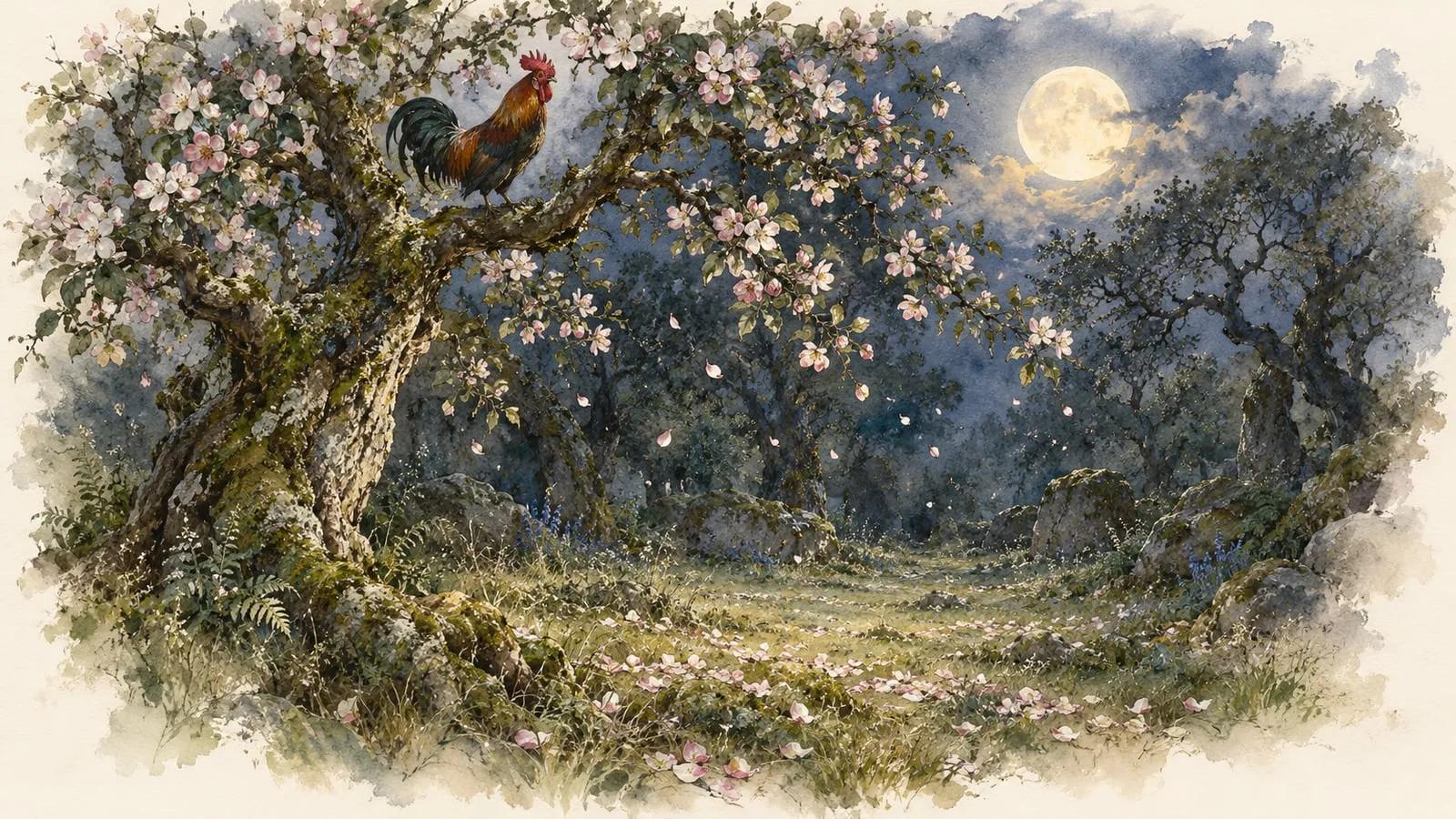
She sees "A sweetheart from another life" floating on the water, lingering from "vague distress / Or arrogant loveliness". The phantom lifts a tress of hair "Among the starry eddies" on a pale finger, and the stars in the stream become the stars in her hair.
Lines 29 to 35His reassurance
He asks why she should start in fear, with him at her shoulder, imagining that any night could raise an image except "images to make me fonder". Even for eyes "that beauty had driven mad", he insists, his love for her is secure.
Lines 36 to 42The hovering thing
She does not take up his comfort. The phantom "has thrown her arms above her head", whether to "flout" her or simply to let her hair stream on the wind. She cannot tell, and knows only that she is "afraid / Of the hovering thing night brought me."
Themes
Past love
The poem is about the way an earlier love can haunt a later one. The "sweetheart from another life" is seen only by the woman, and only when the man is deeply stirred. His promise of "images to make me fonder" cannot undo what she has seen.
Images
The word "image" runs through the poem: "Image of poignant recollection", "An image of my heart", "An image up". Reflections on the water become images of feeling, and one image becomes a figure with hair and fingers. The line between reflection, memory and ghost is never fixed.
Fear and jealousy
She has passed "Youth's bitterness" and thought herself safe, but her heart is "smitten" again. Her covering his eyes is protective and possessive at once. The poem ends not with his reassurance but with her fear of "the hovering thing".
Context
The poem was collected in Michael Robartes and the Dancer, issued by the Cuala Press in February 1921, soon after Yeats's marriage to George Hyde-Lees in 1917. The idea of lives that recur and images that pass from one life to another belongs to the system the couple were then working out together, later published as A Vision.
It is usually read as a scene between Yeats and his wife, with the phantom as the memory of an earlier love, often taken to be Maud Gonne. The poem itself names no one, and its fear works whether the "sweetheart" is a ghost, a memory or a jealous fancy.
Form
A dialogue in six seven-line stanzas, alternating "He" and "She". Each stanza has long lines framing two very short ones, and rhymes abcccab ("stirred", "reflections", "stream", "gleam", "scream", "bird", "recollection"). The triple rhyme in the middle of each stanza gives a brief, chiming intensity before the long lines return.
Yeats's own note
Robartes writes to Aherne under the date May 12th, 1917. “I found among the Judwalis much biographical detail, probably legendary, about Kusta-ben-Luki. He saw occasionally during sleep a woman’s face and later on found in a Persian painting a face resembling, though not identical with the dream-face, which was he considered that of a woman loved in another life. Presently he met & loved a beautiful woman whose face also resembled, without being identical, that of his dream. Later on he made a long journey to purchase the painting which was, he said, the better likeness, and found on his return that his mistress had left him in a fit of jealousy.” In a dialogue and in letters, Robartes gives a classification and analysis of dreams which explain the survival of this story among the followers of Kusta-ben-Luki. They distinguished between the memory of concrete images and the abstract memory, and affirm that no concrete dream-image is ever from our memory. This is not only true they say of dreams, but of those visions seen between sleeping and waking. This doctrine at first found me incredulous, for I thought it contradicted by my experience and by all I have read, not however a very great amount, in books of psychology and of psychoanalysis. Did I not frequently dream of some friend, or relation, or that I was at school? I found, however, when I studied my dreams, as I was directed in a dialogue, that the image seen was never really that of friend, or relation, or my old school, though it might very closely resemble it. A substitution had taken place, often a very strange one, though I forgot this if I did not notice it at once on waking. The name of some friend, or the conceptions “my father” and “at school,” are a part of the abstract memory and therefore of the dream life, but the image of my father, or my friend, or my old school, being a part of the personal concrete memory appeared neither in sleep nor in visions between sleep and waking. I found sometimes that my father, or my friend, had been represented in sleep by a stool or a chair, and I concluded that it was the entire absence of my personal concrete memory that enabled me to accept such images without surprise. Was it not perhaps this very absence that constituted sleep? Would I perhaps awake if a single concrete image from my memory came before me? Even these images—stool, chair, etc. were never any particular stool, chair, etc. that I had known. Were these images, however, from the buried memory? had they floated up from the subconscious? had I seen them perhaps a long time ago and forgotten having done so? Even if that were so, the exclusion of the conscious memory was a new, perhaps important truth; but Robartes denied their source even in the subconscious. It seems a corroboration that though I often see between sleep and waking elaborate landscape, I have never seen one that seemed a possible representation of any place I have ever lived near from childhood up. Robartes traces these substitute images to different sources. Those that come in sleep are (1) from the state immediately preceding our birth; (2) from the Spiritus Mundi—that is to say, from a general storehouse of images which have ceased to be a property of any personality or spirit. Those that come between sleeping and waking are, he says, reshaped by what he calls the “automatic faculty” which can create pattern, balance, etc. from the impressions made upon the senses, not of ourselves, but of others bound to us by certain emotional links though perhaps entire strangers, and preserved in a kind of impersonal mirror, often simply called the “record,” which takes much the same place in his system the lower strata of the astral light does among the disciples of Elephas Levi. This does not exhaust the contents of dreams for we have to account also for certain sentences, for certain ideas which are not concrete images and yet do not arise from our personal memory, but at the moment I have merely to account for certain images that affect passion or affection. Robartes writes to Aherne in a letter dated May 15th, 1917: “No lover, no husband has ever met in dreams the true image of wife or mistress. She who has perhaps filled his whole life with joy or disquiet cannot enter there. Her image can fill every moment of his waking life but only its counterfeit comes to him in sleep; and he who classifies these counterfeits will find that just in so far as they become concrete, sensuous, they are distinct individuals; never types but individuals. They are the forms of those whom he has loved in some past earthly life, chosen from Spiritus Mundi by the subconscious will, and through them, for they are not always hollow shades, the dead at whiles outface a living rival.” They are the forms of Over Shadowers as they are called. All violent passion has to be expiated or atoned, by one in life, by one in the state between life and life, because, as the Judwalis believe, there is always deceit or cruelty; but it is only in sleep that we can see these forms of those who as spirits may influence all our waking thought. Souls that are once linked by emotion never cease till the last drop of that emotion is exhausted—call it desire, hate or what you will—to affect one another, remaining always as it were in contact. Those whose past passions are unatoned seldom love living man or woman but only those loved long ago, of whom the living man or woman is but a brief symbol forgotten when some phase of some atonement is finished; but because in general the form does not pass into the memory, it is the moral being of the dead that is symbolised. Under certain circumstances, which are precisely described, the form indirectly, and not necessarily from dreams, enters the living memory; the subconscious will, as in Kusta-ben-Luki in the story, selects among pictures, or other ideal representations, some form that resembles what was once the physical body of the Over Shadower, and this ideal form becomes to the living man an obsession, continually perplexing and frustrating natural instinct. It is therefore only after full atonement or expiation, perhaps after many lives, that a natural deep satisfying love becomes possible, and this love, in all subjective natures, must precede the Beatific Vision.
When I wrote “An Image from a Past Life,” I had merely begun my study of the various papers upon the subject, but I do not think I misstated Robartes’ thought in permitting the woman and not the man to see the Over Shadower or Ideal Form, whichever it was. No mind’s contents are necessarily shut off from another, and in moments of excitement images pass from one mind to another with extraordinary ease, perhaps most easily from that portion of the mind which for the time being is outside consciousness. I use the word “pass” because it is familiar, not because I believe any movement in space to be necessary. The second mind sees what the first has already seen, that is all.