The Poet pleads with the Elemental Powers
Earlier titled "Aedh pleads with the Elemental Powers"
Listen
Text: Poetry, by W. B. Yeats (Standard Ebooks, 2024), from the collected editions of 1908 to 1928. Public domain.
In brief
SummaryThe poet begs the powers of nature to bring his beloved peace.
The poem opens on a cosmic loss: nameless Powers have "pulled the Immortal Rose", and though the Seven Lights wept, the Polar Dragon slept on. The speaker then turns to the Powers of wave, wind and fire and asks them to surround the woman he loves with music and "sing her into peace", so that his own long care can end. In the last stanza he prays that she will no longer be like a storm-troubled sea, and that "a gentle silence wrought with music" will follow wherever she walks. Behind the grand symbols is a simple wish for her calm.
Lines to remember
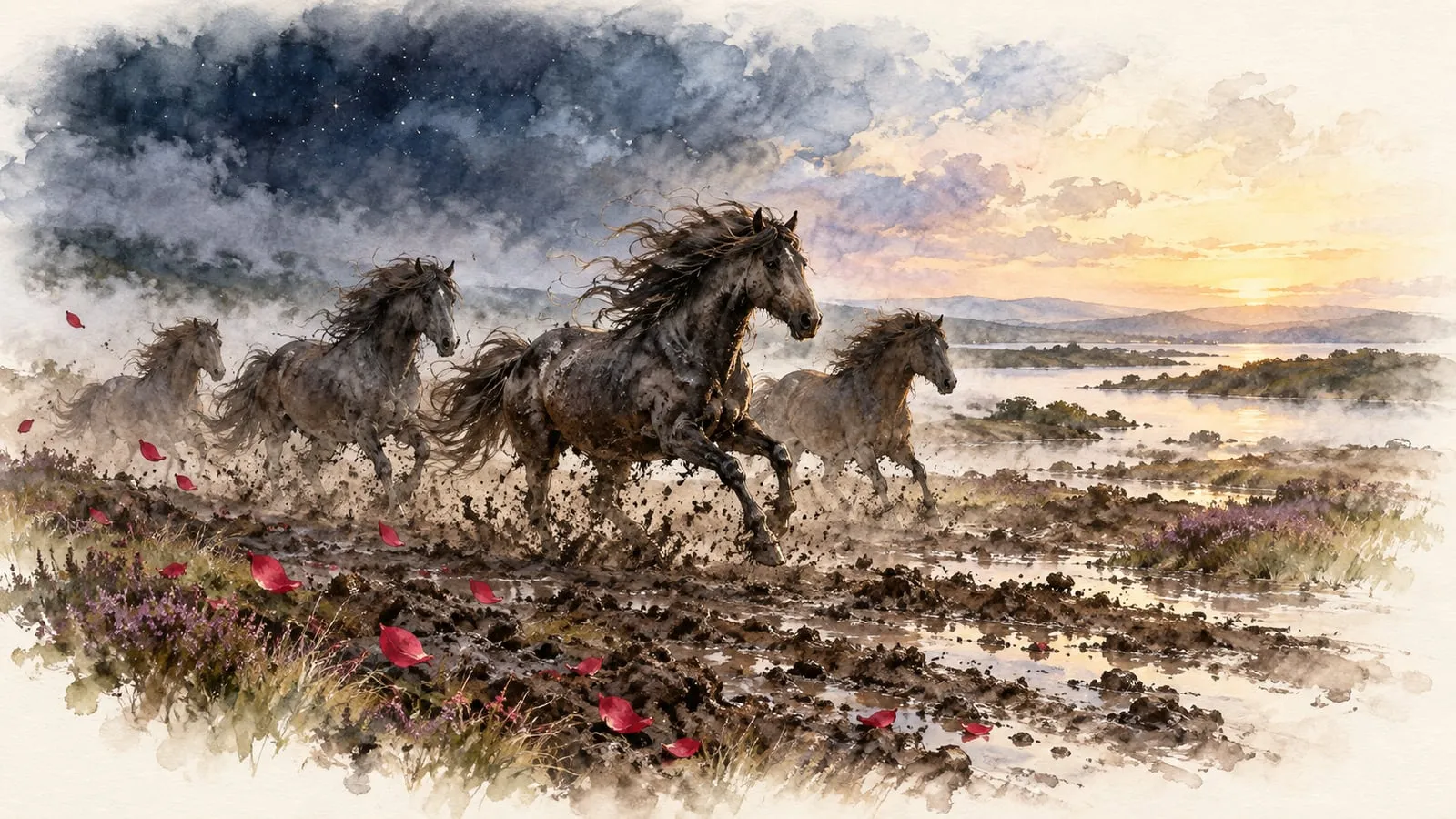
Encircle her I love and sing her into peace,
But let a gentle silence wrought with music flow
Line by line
Lines 1 to 6The Rose pulled down
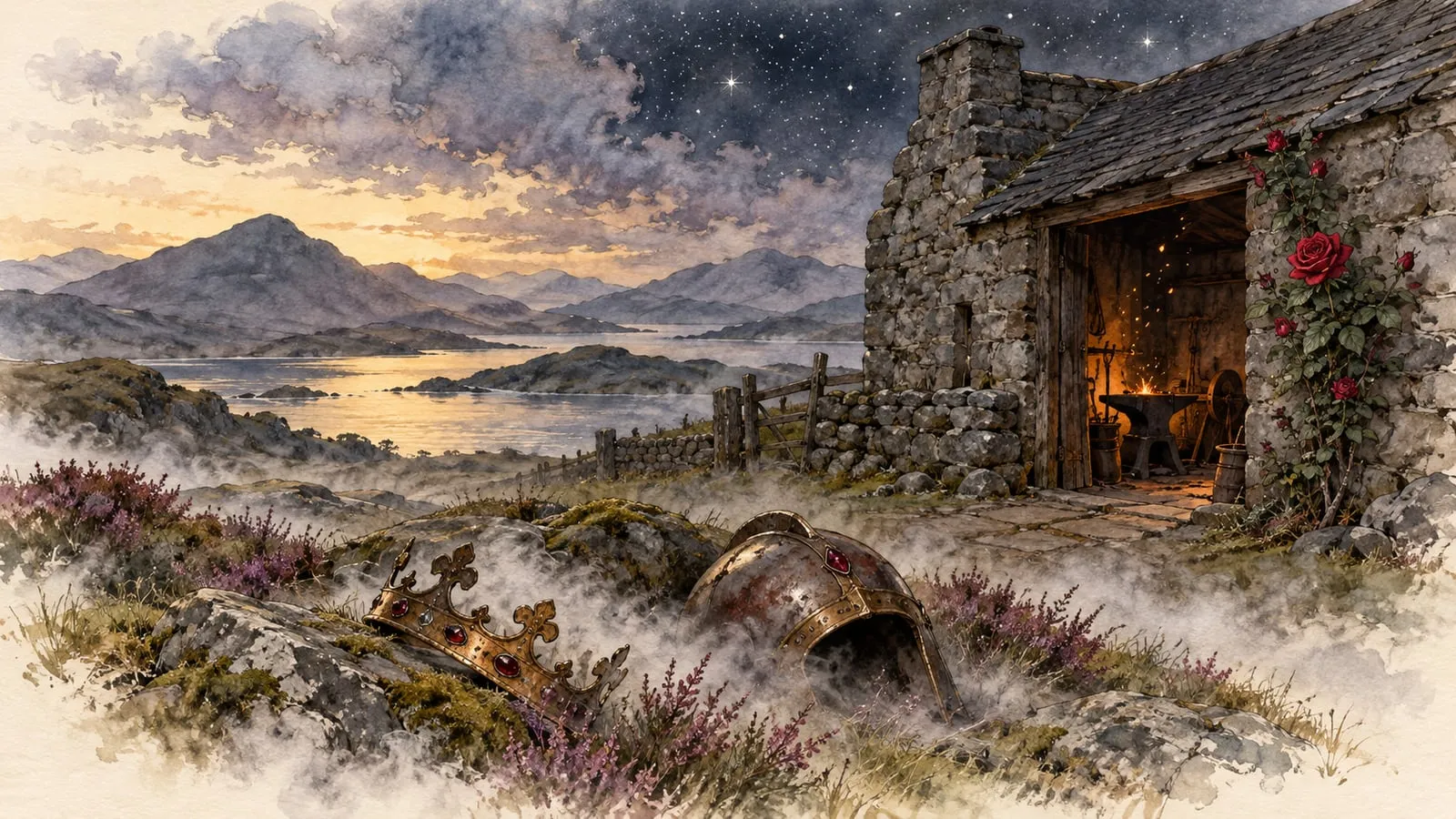
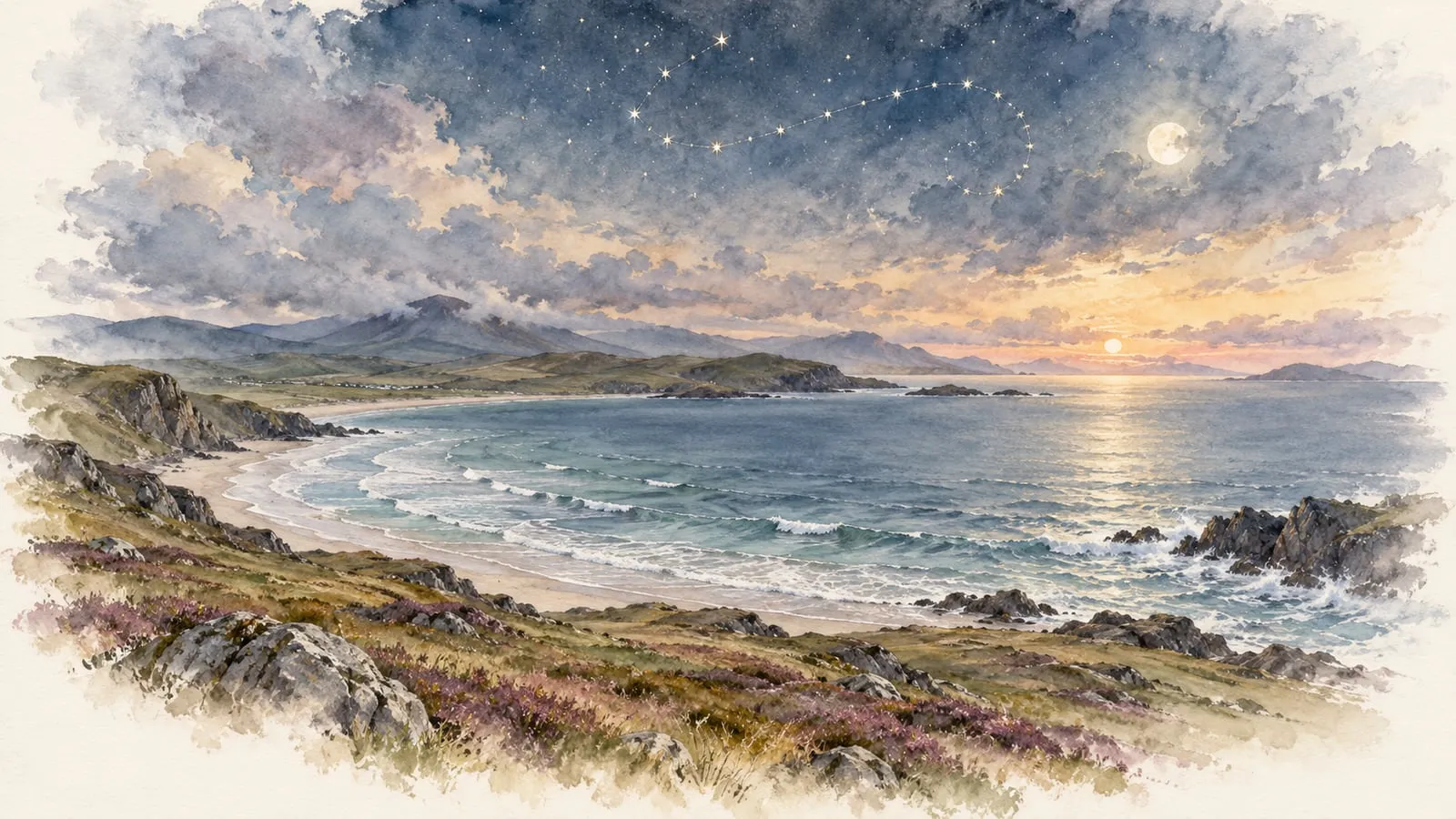
Powers no living creature can name or picture "Have pulled the Immortal Rose". The Seven Lights, probably the stars of the Plough, bow and weep, but "The Polar Dragon slept", coiled "from glimmering deep to deep". The stanza ends on a question: "When will he wake from sleep?"
Lines 7 to 12Wave, wind and fire
He appeals to "Great Powers of falling wave and wind and windy fire" and their "harmonious choir": let them "Encircle her I love and sing her into peace", so that "my old care may cease". He asks them to spread "flaming wings" and hide "The nets of day and night", the snares of time.
Lines 13 to 18Silence and music
The "Dim Powers of drowsy thought" are asked to change her restless nature: she should no longer be "Like the pale cup of the sea" under gathering winds and a dimmed sun and moon. Instead he asks for "a gentle silence wrought with music" to go "Whither her footsteps go".
Themes
Peace for the beloved
The whole invocation is for her sake. Each stanza names Powers and then asks for calm: she is to be sung "into peace", sheltered under wings, and followed by "a gentle silence". The pale, storm-troubled sea is his picture of her restlessness, and his own "old care" will end only when hers does.
Occult symbolism
The Rose, the Seven Lights and the Polar Dragon come from Yeats's study of magic and the stars. Pulling down "the Immortal Rose" suggests that ideal beauty has been lost from the world, while the sleeping Dragon waits to wake, perhaps at the end of time. The poem reads like a ritual, calling spirits by their elements: wave, wind, fire, thought.
Context
First collected in The Wind Among the Reeds (1899) as "Aedh pleads with the Elemental Powers". Aedh was one of the named voices Yeats gave to the love poems in that book; from 1906 the title changed. The poem draws on the ritual magic Yeats was studying in the 1890s as a member of the Hermetic Order of the Golden Dawn.
Form
Three six-line stanzas in rhyming couplets, each pairing a long six-beat line with a short three-beat one ("knows" and "Rose", "fire" and "choir", "flow" and "go"). The long lines carry the grand invocations and the short ones fall back like responses. Each stanza opens by naming the Powers, like the steps of a ritual.
Yeats's own note
“The Poet Pleads with the Elemental Powers;” “He Thinks of His Past Greatness When a Part of the Constellations of Heaven;” “He Hears the Cry of the Sedge.”—The Rose has been for many centuries a symbol of spiritual love and supreme beauty. The lotus was in some Eastern countries imagined blossoming upon the Tree of Life, as the Flower of Life, and is thus represented in Assyrian bas-reliefs. Because the Rose, the flower sacred to the Virgin Mary, and the flower that Apuleius’ adventurer ate, when he was changed out of the ass’s shape and received into the fellowship of Isis, is the western Flower of Life, I have imagined it growing upon the Tree of Life. I once stood beside a man in Ireland when he saw it growing there in a vision, that seemed to have rapt him out of his body. He saw the Garden of Eden walled about, and on the top of a high mountain, as in certain medieval diagrams, and after passing the Tree of Knowledge, on which grew fruit full of troubled faces, and through whose branches flowed, he was told, sap that was human souls, he came to a tall, dark tree, with little bitter fruits, and was shown a kind of stair or ladder going up through the tree, and told to go up; and near the top of the tree, a beautiful woman, like the Goddess of Life, associated with the tree in Assyria, gave him a rose that seemed to have been growing upon the tree. One finds the Rose in the Irish poets, sometimes as a religious symbol, as in the phrase, “the Rose of Friday,” meaning the Rose of austerity, in a Gaelic poem in Dr. Hyde’s Religious Songs of Connacht; and, I think, as a symbol of woman’s beauty in the Gaelic song, “Roseen Dubh”; and a symbol of Ireland in Mangan’s adaptation of “Roseen Dubh,” “My Dark Rosaleen,” and in Mr. Aubrey de Vere’s “The Little Black Rose.” I do not know any evidence to prove whether this symbol came to Ireland with medieval Christianity, or whether it has come down from older times. I have read somewhere that a stone engraved with a Celtic god, who holds what looks like a rose in one hand, has been found somewhere in England; but I cannot find the reference, though I certainly made a note of it. If the Rose was really a symbol of Ireland among the Gaelic poets, and if “Roseen Dubh” is really a political poem, as some think, one may feel pretty certain that the ancient Celts associated the Rose with Eire, or Fotla, or Banba—goddesses who gave their names to Ireland—or with some principal god or goddess, for such symbols are not suddenly adopted or invented, but come out of mythology.
I have made the Seven Lights, the constellation of the Bear, lament for the theft of the Rose, and I have made the Dragon, the constellation Draco, the guardian of the Rose, because these constellations move about the pole of the heavens, the ancient Tree of Life in many countries, and are often associated with the Tree of Life in mythology. It is this Tree of Life that I have put into the “Song of Mongan” under its common Irish form of a hazel; and, because it had sometimes the stars for fruit, I have hung upon it “the Crooked Plough” and the “Pilot Star,” as Gaelic-speaking Irishmen sometimes call the Bear and the North star. I have made it an axletree in “Aedh hears the Cry of the Sedge,” for this was another ancient way of representing it.
Title only: 1899 persona title "Aedh pleads with the Elemental Powers" (Gutenberg 32233) replaced from 1906 (Gutenberg 49608). Check wording against the 1899 text before choosing a version.