The Host of the Air
Listen
Text: Poetry, by W. B. Yeats (Standard Ebooks, 2024), from the collected editions of 1908 to 1928. Public domain.
In brief
SummaryA young man is lured into a game while faeries steal his bride.
O'Driscoll is driving wild duck from the reeds of Hart Lake at nightfall, singing and dreaming of his bride, Bridget. He hears a piper, sad and gay at once, and sees young people dancing, Bridget among them. The dancers offer him red wine and white bread, but Bridget draws him away to old men playing cards. The food carries "a doom": these are "the host of the air", the faeries. While he plays, lost in a dream of her hair, the handsomest young man carries Bridget off. When O'Driscoll scatters the cards and wakes, everyone has vanished like smoke, and only the piping sounds, high in the air.
Lines to remember
And never was piping so sad,
And never was piping so gay.
Were gone like a drifting smoke;
Line by line
Lines 1 to 8At Hart Lake
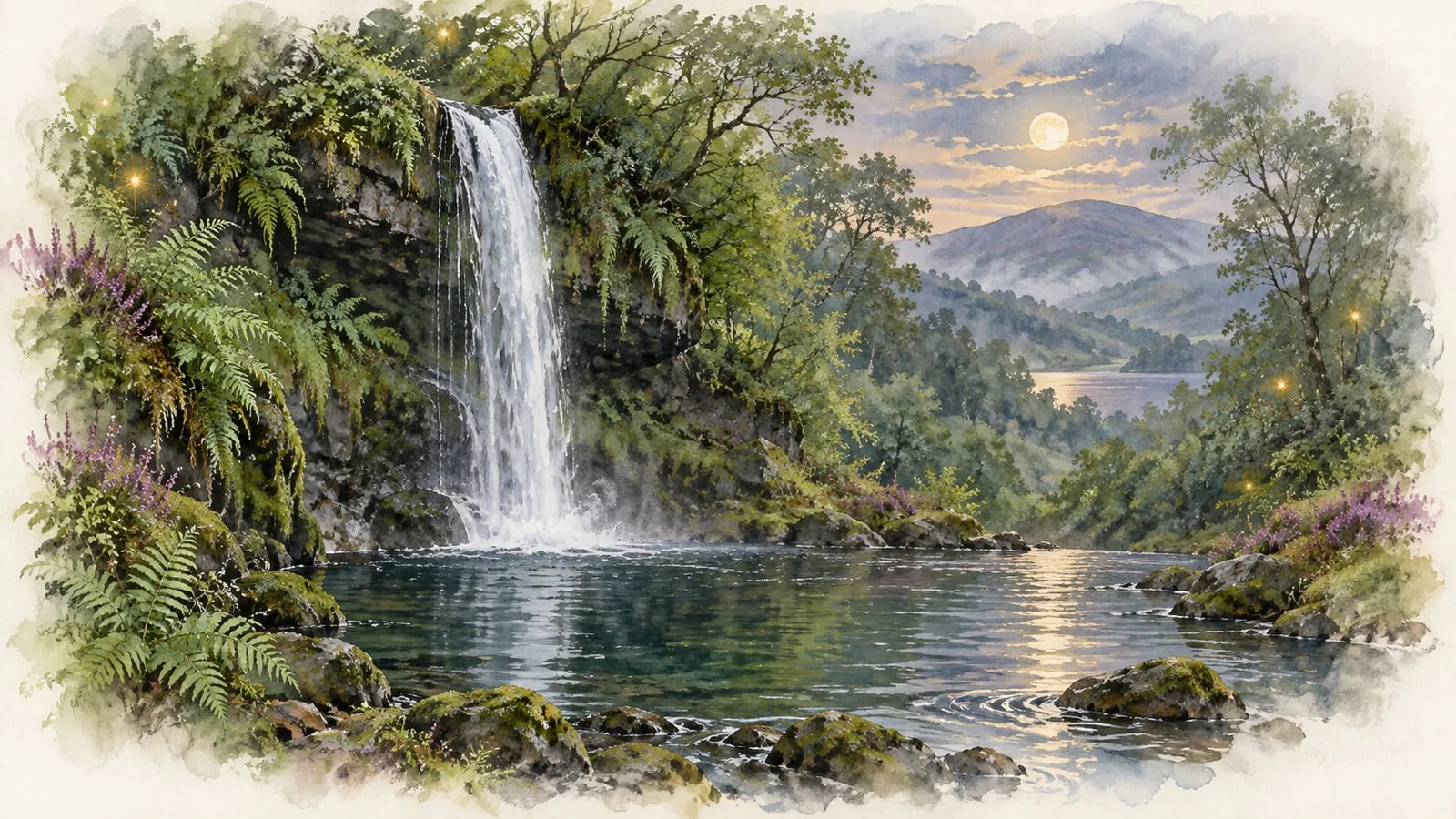
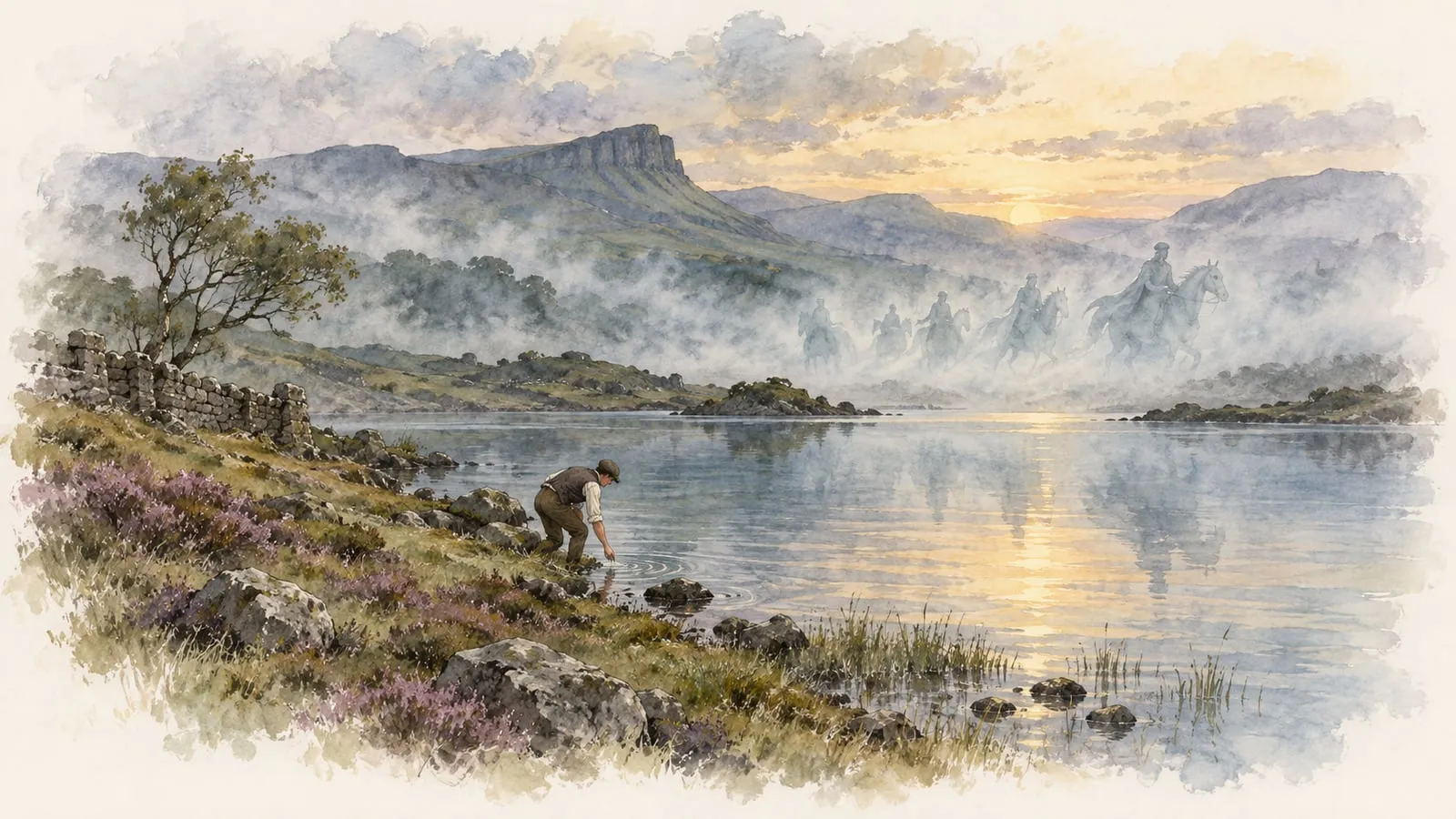
O'Driscoll drives the wild duck and drake from the reeds of "the drear Hart Lake". As the reeds darken with nightfall, he dreams of the "long dim hair" of "Bridget his bride". That hair will return at each turn of the story.
Lines 9 to 16The piper and the dance
He hears a piper whose music is at once sad and gay, and sees young men and girls who dance "on a level place". Bridget is among them "With a sad and a gay face", a first hint that she already belongs half to the other world.
Lines 17 to 24Wine, bread and cards
The dancers crowd round him with sweet words, and a young man and girl bring him "red wine" and "white bread". Bridget draws him by the sleeve, away from the merry bands, to old men playing cards "With a twinkling of ancient hands".
Lines 25 to 28The host of the air
The narrator steps in: the bread and wine "had a doom", for these are "the host of the air", the faeries. O'Driscoll sits and plays, lost in a dream "Of her long dim hair".
Lines 29 to 36Bridget taken
Absorbed in the game, he thinks "not of evil chance" until one of them carries Bridget away, "The handsomest young man there". His neck, breast and arms are "drowned in her long dim hair", so the stranger has what O'Driscoll only dreamed of.
Lines 37 to 44Gone like smoke
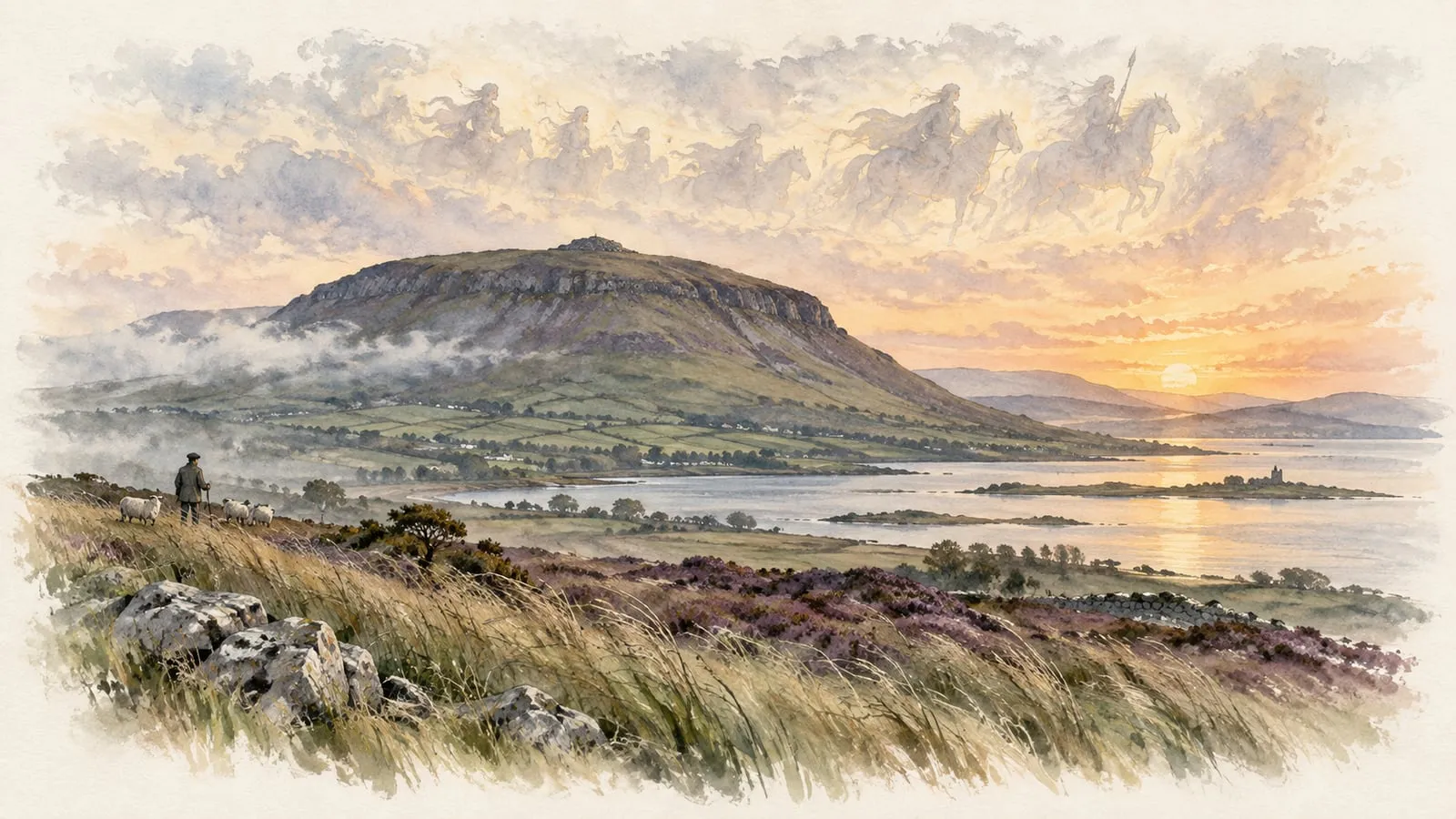
O'Driscoll scatters the cards "And out of his dream awoke". The whole company is "gone like a drifting smoke". The last stanza repeats the piper's lines from the third, but now the music comes from "high up in the air", out of reach.
Themes
Faery abduction
The story follows the old Irish belief that the faeries steal young brides away. Everything in it keeps to folk rules: food that dooms whoever eats it, a dance on a level place, a vanishing like smoke. The host is charming and never violent, which makes the loss more eerie: Bridget is simply carried "Away from the merry dance".
Dream and waking
O'Driscoll dreams all through the poem: of Bridget's hair at the lake, and again "in a dream" at cards. His dreaming is what lets the faeries take her. Only when he scatters the cards does he wake, too late. Longing, the poem suggests, can slide into a trance that costs a man what he loves.
Joy and sorrow
The piper's music is "so sad" and "so gay" at once, and Bridget has "a sad and a gay face". The faery world mixes the two feelings in a way human life keeps apart. The repeated lines make that double music the poem's frame, sounding near its start and at its end.
Context
The poem appeared in The Wind Among the Reeds (1899). It is one of Yeats's retellings of Irish faery lore in ballad form, drawing on the country belief that the faeries, the "host of the air", carried off young brides, and that eating their food bound a mortal to them.
Form
Eleven quatrains of short, three-beat lines rhymed ABCB, in the manner of a folk ballad. Several stanzas end on a clipped line ("Of Bridget his bride"). Refrains bind the story together: the sad and gay piping in stanzas three and eleven, and the "long dim hair" that returns three times.
Yeats's own note
Some writers distinguish between the Sluagh Gaoith, the host of the air, and Sluagh Sidhe, the host of the Sidhe, and describe the host of the air as of a peculiar malignancy. Dr. Joyce says, “Of all the different kinds of goblins … air demons were most dreaded by the people. They lived among clouds, and mists, and rocks, and hated the human race with the utmost malignity.” A very old Aran charm, which contains the words “Send God, by his strength, between us and the host of the Sidhe, between us and the host of the air,” seems also to distinguish among them. I am inclined, however, to think that the distinction came in with Christianity and its belief about the prince of the air, for the host of the Sidhe, as I have already explained, are closely associated with the wind.
They are said to steal brides just after their marriage, and sometimes in a blast of wind. A man in Galway says, “At Aughanish there were two couples came to the shore to be married, and one of the newly married women was in the boat with the priest, and they going back to the island; and a sudden blast of wind came, and the priest said some blessed words that were able to save himself, but the girl was swept.”
This woman was drowned; but more often the persons who are taken “get the touch,” as it is called, and fall into a half dream, and grow indifferent to all things, for their true life has gone out of the world, and is among the hills and the forts of the Sidhe. A faery doctor has told me that his wife “got the touch” at her marriage because there was one of them wanted her; and the way he knew for certain was, that when he took a pitchfork out of the rafters, and told her it was a broom, she said, “It is a broom.” She was, the truth is, in the magical sleep, to which people have given a new name lately, that makes the imagination so passive that it can be moulded by any voice in any world into any shape. A mere likeness of some old woman, or even old animal, some one or some thing the Sidhe have no longer a use for, is believed to be left instead of the person who is “away”; this some one or some thing can, it is thought, be driven away by threats, or by violence (though I have heard country women say that violence is wrong), which perhaps awakes the soul out of the magical sleep. The story in the poem is founded on an old Gaelic ballad that was sung and translated for me by a woman at Ballisodare in County Sligo; but in the ballad the husband found the keeners keening his wife when he got to his house. She was “swept” at once; but the Sidhe are said to value those the most whom they but cast into a half dream, which may last for years, for they need the help of a living person in most of the things they do. There are many stories of people who seem to die and be buried—though the country people will tell you it is but some one or some thing put in their place that dies and is buried—and yet are brought back afterwards. These tales are perhaps memories of true awakenings out of the magical sleep, moulded by the imagination, under the influence of a mystical doctrine which it understands too literally, into the shape of some well-known traditional tale. One does not hear them as one hears the others, from the persons who are “away,” or from their wives or husbands; and one old man, who had often seen the Sidhe, began one of them with “Maybe it is all vanity.”
Here is a tale that a friend of mine heard in the Burren hills, and it is a type of all:—
“There was a girl to be married, and she didn’t like the man, and she cried when the day was coming, and said she wouldn’t go along with him. And the mother said, ‘Get into the bed, then, and I’ll say that you’re sick.’ And so she did. And when the man came the mother said to him, ‘You can’t get her, she’s sick in the bed.’ And he looked in and said, ‘That’s not my wife that’s in the bed, it’s some old hag.’ And the mother began to cry and roar. And he went out and got two hampers of turf, and made a fire, that they thought he was going to burn the house down. And when the fire was kindled, ‘Come out, now,’ says he, ‘and we’ll see who you are, when I’ll put you on the fire.’ And when she heard that, she gave one leap, and was out of the house, and they saw, then, it was an old hag she was. Well, the man asked the advice of an old woman, and she bid him go to a faery-bush that was near, and he might get some word of her. So he went there at night, and saw all sorts of grand people, and they in carriages or riding on horses, and among them he could see the girl he came to look for. So he went again to the old woman, and she said, ‘If you can get the three bits of blackthorn out of her hair, you’ll get her again.’ So that night he went again, and that time he only got hold of a bit of her hair. But the old woman told him that was no use, and that he was put back now, and it might be twelve nights before he’d get her. But on the fourth night he got the third bit of blackthorn, and he took her, and she came away with him. He never told the mother he had got her; but one day she saw her at a fair, and, says she, ‘That’s my daughter; I know her by the smile and by the laugh of her, and she with a shawl about her head.’ So the husband said, ‘You’re right there, and hard I worked to get her.’ She spoke often of the grand things she saw underground, and how she used to have wine to drink, and to drive out in a carriage with four horses every night. And she used to be able to see her husband when he came to look for her, and she was greatly afraid he’d get a drop of the wine, for then he would have come underground and never left it again. And she was glad herself to come to earth again, and not to be left there.”
The old Gaelic literature is full of the appeals of the Tuatha De Danaan to mortals whom they would bring into their country; but the song of Midher to the beautiful Etain, the wife of the king who was called Echaid the ploughman, is the type of all.
“O beautiful woman, come with me to the marvellous land where one listens to a sweet music, where one has spring flowers in one’s hair, where the body is like snow from head to foot, where no one is sad or silent, where teeth are white and eyebrows are black … cheeks red like foxglove in flower. … Ireland is beautiful, but not so beautiful as the Great Plain I call you to. The beer of Ireland is heady, but the beer of the Great Plain is much more heady. How marvellous is the country I am speaking of! Youth does not grow old there. Streams with warm flood flow there; sometimes mead, sometimes wine. Men are charming and without a blot there, and love is not forbidden there. O woman, when you come into my powerful country you will wear a crown of gold upon your head. I will give you the flesh of swine, and you will have beer and milk to drink, O beautiful woman. O beautiful woman, come with me!”