The Hosting of the Sidhe
Earlier titled "The Hosting of the Shide"
Listen
Text: Poetry, by W. B. Yeats (Standard Ebooks, 2024), from the collected editions of 1908 to 1928. Public domain.
In brief
SummaryThe faery host rides out, calling mortals to abandon their dreams.
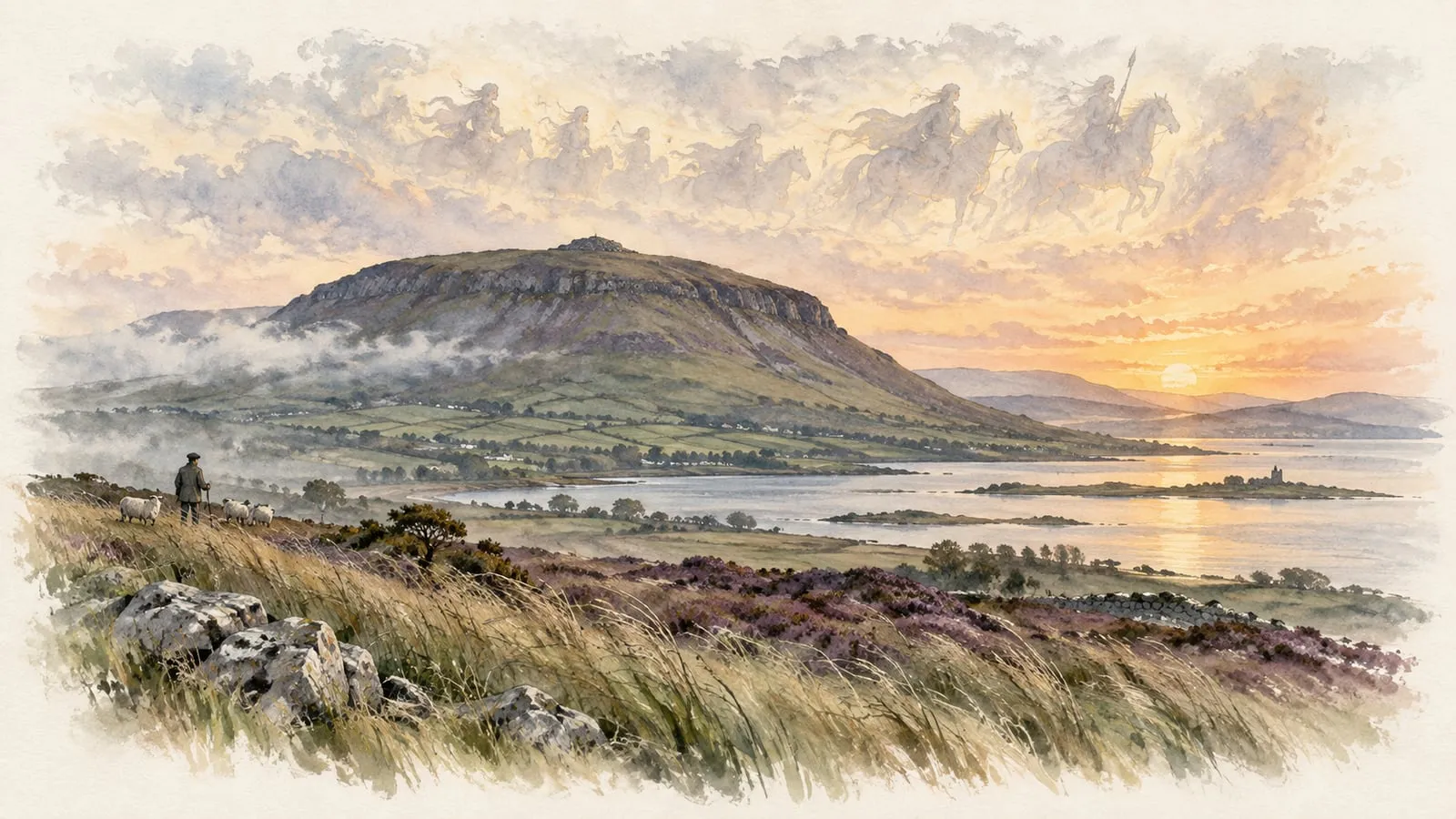
The Sidhe, the faery people of Irish legend, are riding across the Sligo country from Knocknarea. At their head are Caolte, tossing his burning hair, and Niamh, calling "Away, come away". Midway the poem switches voice: the riders speak for themselves, with pale cheeks, unbound hair and heaving breasts, and warn that anyone who gazes on them will lose both "the deed of his hand" and "the hope of his heart". The last lines repeat the opening, so the host seems to sweep past and keep going. It is a poem of wild, dangerous glamour.
Lines to remember
And Niamh calling Away, come away:
Empty your heart of its mortal dream.
We come between him and the hope of his heart.
Line by line
Lines 1 to 5The host rides
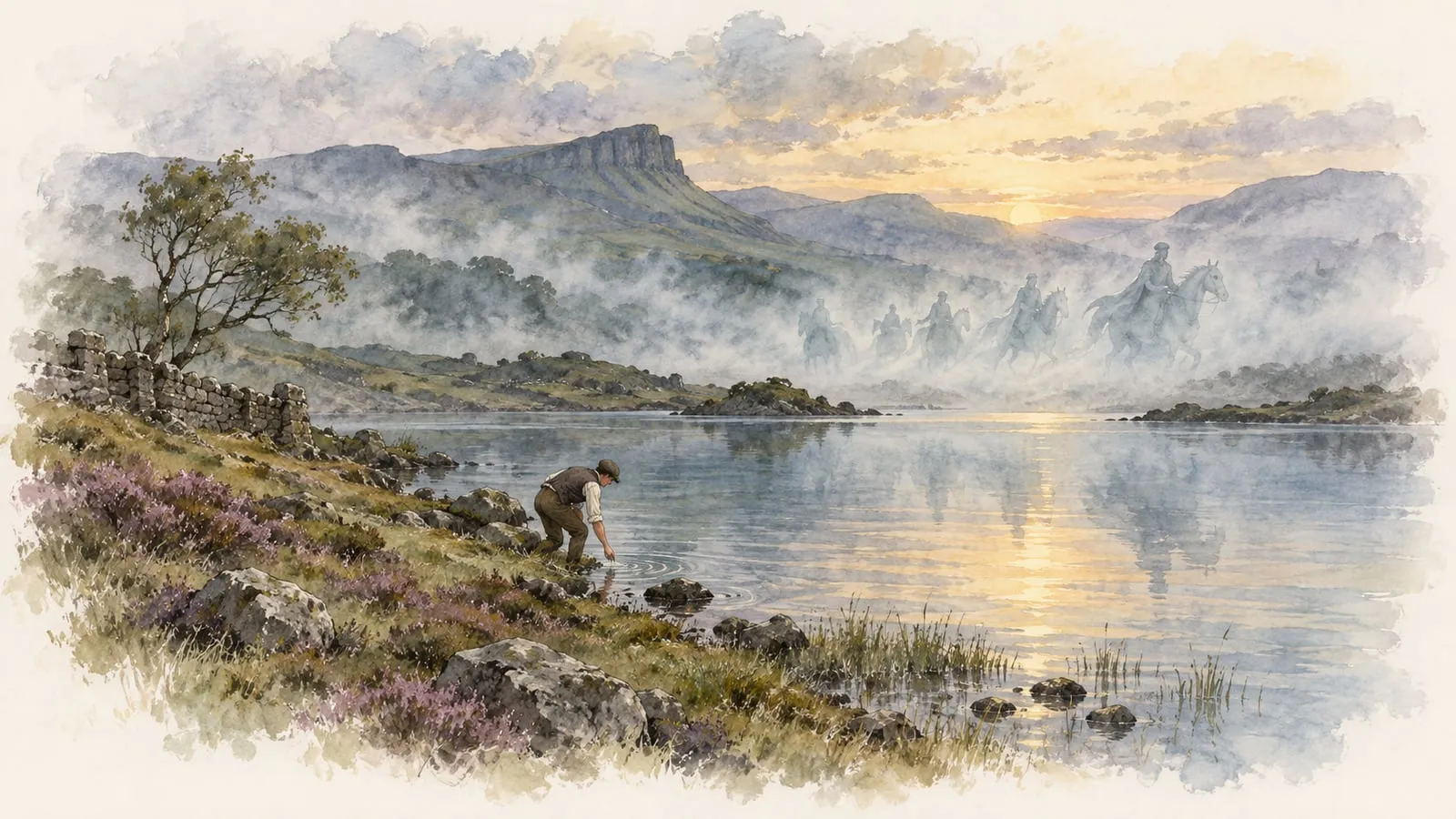
The host rides from Knocknarea and over the grave of Clooth-na-Bare. Caolte tosses "his burning hair" and Niamh calls "Away, come away", urging the listener to "Empty your heart of its mortal dream". Human life itself is the dream here; the faery world claims to be more real.
Lines 6 to 12The riders speak
Now "Our" takes over: the Sidhe describe themselves in a rush of short clauses, winds awakening, leaves whirling, cheeks pale, eyes "agleam". Their threat is quiet and total. Whoever looks at them loses his purpose: "We come between him and the hope of his heart."
Lines 13 to 16Sweeping on
The host rushes "'twixt night and day", in the twilight hour. A single challenge, "where is there hope or deed as fair?", sets their beauty above all human effort, and then the opening lines return as the riders pass on.
Themes
Faery enchantment
The Sidhe are beautiful and perilous. Their call, "Away, come away", is an invitation to leave ordinary life for good. Anyone who gazes on them is changed: they come "between him and the deed of his hand". Much of the poem's excitement comes from never deciding whether this is liberation or loss.
Wind and movement
Everything in the poem moves: the host rides and rushes, "The winds awaken", leaves "whirl round", arms wave and hair is unbound. In Irish folklore the faeries were thought to travel in whirlwinds, and the poem's rhythm, with its quick, skipping beats, feels like a gust passing through.
Context
The poem opens The Wind Among the Reeds (1899), the book in which Yeats's early style reached its most elaborate. Knocknarea is the hill west of Sligo topped by the great cairn traditionally called Queen Maeve's grave, and it recurs in his early poems of the Sidhe.
Caolte was one of the Fianna, the war band of Finn mac Cumhaill, famed for his speed. Niamh is the faery woman who carried Oisin away to the Land of Youth, the story Yeats had told in The Wanderings of Oisin (1889).
Form
Sixteen lines with four strong beats and quick, skipping syllables between them. The rhymes fold inwards in groups of four, ABBA ("Knocknarea", "Clooth-na-Bare", "hair", "away"). The run of lines beginning "Our" and "We come" gives the middle a chanting drive, and lines 15 and 16 repeat lines 3 and 4.
Yeats's own note
The gods of ancient Ireland, the Tuatha De Danaan, or the Tribes of the goddess Danu, or the Sidhe, from Aes Sidhe, or Sluagh Sidhe, the people of the Faery Hills, as these words are usually explained, still ride the country as of old. Sidhe is also Gaelic for wind, and certainly the Sidhe have much to do with the wind. They journey in whirling wind, the winds that were called the dance of the daughters of Herodias in the Middle Ages, Herodias doubtless taking the place of some old goddess. When the country people see the leaves whirling on the road they bless themselves, because they believe the Sidhe to be passing by. They are almost always said to wear no covering upon their heads, and to let their hair stream out; and the great among them, for they have great and simple, go much upon horseback. If anyone becomes too much interested in them, and sees them overmuch, he loses all interest in ordinary things.
A woman near Gort, in Galway, says: “There is a boy, now, of the Clorans; but I wouldn’t for the world let them think I spoke of him; it’s two years since he came from America, and since that time he never went to Mass, or to church, or to fairs, or to market, or to stand on the cross roads, or to hurling, or to nothing. And if anyone comes into the house, it’s into the room he’ll slip, not to see them; and as to work, he has the garden dug to bits, and the whole place smeared with cow dung; and such a crop as was never seen; and the alders all plaited till they look grand. One day he went as far as the chapel; but as soon as he got to the door he turned straight round again, as if he hadn’t power to pass it. I wonder he wouldn’t get the priest to read a Mass for him, or something; but the crop he has is grand, and you may know well he has some to help him.” One hears many stories of the kind; and a man whose son is believed to go out riding among them at night tells me that he is careless about everything, and lies in bed until it is late in the day. A doctor believes this boy to be mad. Those that are at times “away,” as it is called, know all things, but are afraid to speak. A countryman at Kiltartan says, “There was one of the Lydons—John—was away for seven years, lying in his bed, but brought away at nights, and he knew everything; and one, Kearney, up in the mountains, a cousin of his own, lost two hoggets, and came and told him, and he knew the very spot where they were, and told him, and he got them back again. But they were vexed at that, and took away the power, so that he never knew anything again, no more than another.”
Knocknarea is in Sligo, and the country people say that Maeve, still a great queen of the western Sidhe, is buried in the cairn of stones upon it. I have written of Clooth-na-Bare in The Celtic Twilight. She “went all over the world, seeking a lake deep enough to drown her faery life, of which she had grown weary, leaping from hill to hill, and setting up a cairn of stones wherever her feet lighted, until, at last, she found the deepest water in the world in little Lough Ia, on the top of the bird mountain, in Sligo.” I forget, now, where I heard this story, but it may have been from a priest at Collooney. Clooth-na-Bare would mean the old woman of Bare, but is evidently a corruption of Cailleac Bare, the old woman of Bare, who, under the names Bare, and Berah, and Beri, and Verah, and Dera, and Dhira, appears in the legends of many places. Mr. O’Grady found her haunting Lough Liath high up on the top of a mountain of the Fews, the Slieve Fuadh, or Slieve G-Cullain of old times, under the name of the Cailleac Buillia. He describes Lough Liath as a desolate moon-shaped lake, with made wells and sunken passages upon its borders, and beset by marsh and heather and gray boulders, and closes his “Flight of the Eagle” with a long rhapsody upon mountain and lake, because of the heroic tales and beautiful old myths that have hung about them always. He identifies the Cailleac Buillia with that Meluchra who persuaded Fionn to go to her amid the waters of Lough Liath, and so changed him with her enchantments, that, though she had to free him because of the threats of the Fiana, his hair was ever afterwards as white as snow. To this day the Tuatha De Danaan that are in the waters beckon to men, and drown them in the waters; and Bare, or Dhira, or Meluchra, or whatever name one likes the best, is, doubtless, the name of a mistress among them. Meluchra was daughter of Cullain; and Cullain Mr. O’Grady calls, upon I know not what authority, a form of Lir, the master of waters. The people of the waters have been in all ages beautiful and changeable and lascivious, or beautiful and wise and lonely, for water is everywhere the signature of the fruitfulness of the body and of the fruitfulness of dreams. The white hair of Fionn may be but another of the troubles of those that come to unearthly wisdom and earthly trouble, and the threats and violence of the Fiana against her, a different form of the threats and violence the country people use, to make the Aes Sidhe give up those that are “away.” Bare is now often called an ugly old woman, but in the “Song of Bare,” which Lady Gregory has given in her Saints and Wonders, she laments her lost beauty after the withering of seven hundred years; and Dr. Joyce says that one of her old names was Aebhin, which means beautiful. Aebhin was the goddess of the tribes of northern Leinster; and the lover she had made immortal, and who loved her perfectly, left her, and put on mortality, to fight among them against the stranger, and died on the strand of Clontarf.
Wikisource has a duplicate page with the misspelling 'The Hosting of the Shide'; use the 'Sidhe' page.