The Valley of the Black Pig
Listen
Text: Poetry, by W. B. Yeats (Standard Ebooks, 2024), from the collected editions of 1908 to 1928. Public domain.
In brief
SummaryA vision of a final battle, and a prayer from those weary of empire.
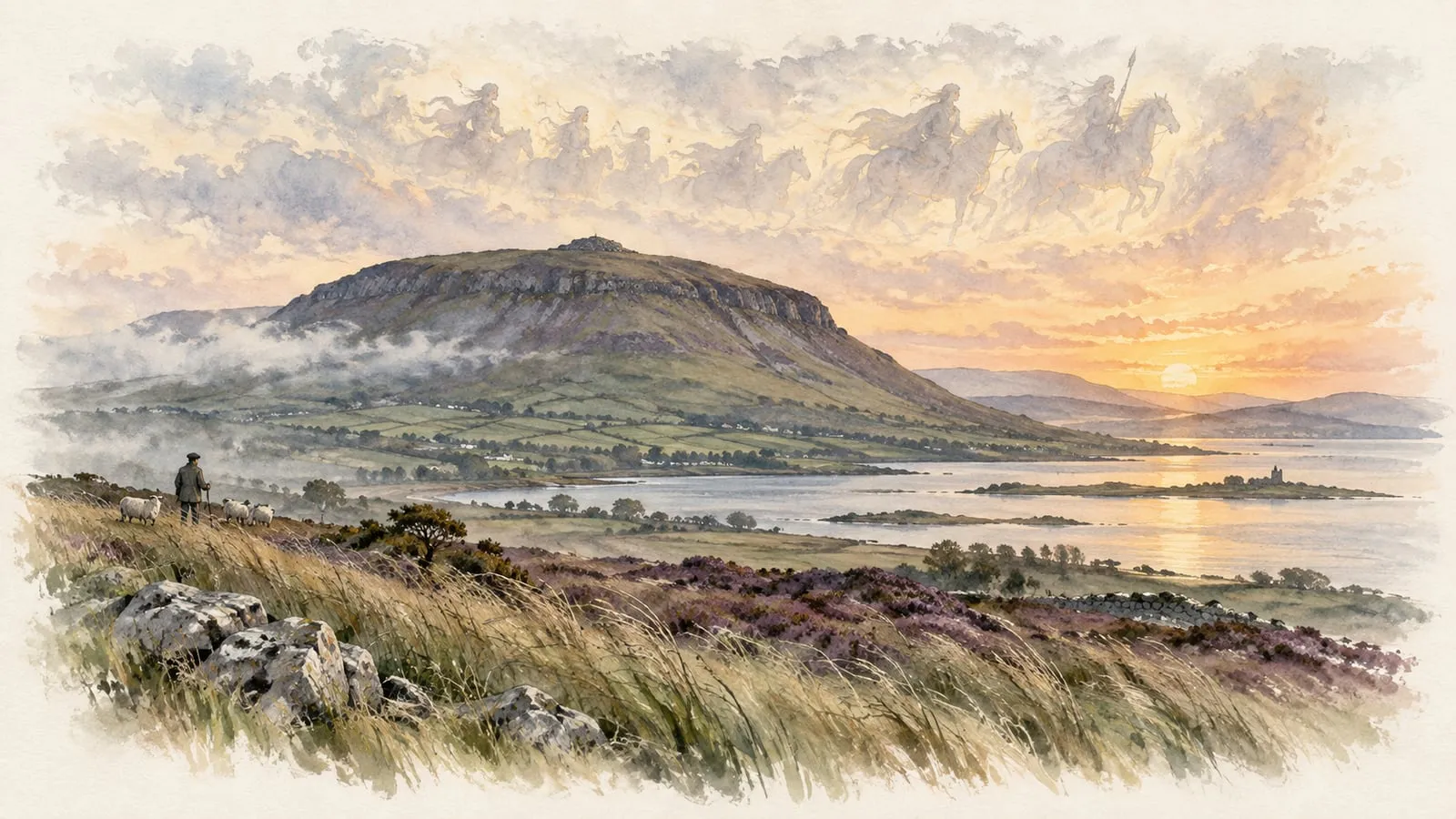
The speaker, drowsing as the dews fall, sees a sudden vision: unknown spears flying, horsemen falling, the cries of dying armies. Then the poem turns to "We", the people who still work by the ancient cromlech and cairn as the day ends. Weary of "the world's empires", they bow down to a divine "Master of the still stars and of the flaming door". In eight lines the poem moves from a dream of war to an act of worship.
Lines to remember
Being weary of the world's empires, bow down to you,
Master of the still stars and of the flaming door.
Line by line
Lines 1 to 4The vision
As "dews drop slowly and dreams gather", the speaker's "dream-awakened eyes" see spears hurtle and hear the clash of horsemen and the cries of "unknown perishing armies". The repeated "unknown" makes the battle vast and nameless, heard more than seen.
Lines 5 to 8The prayer
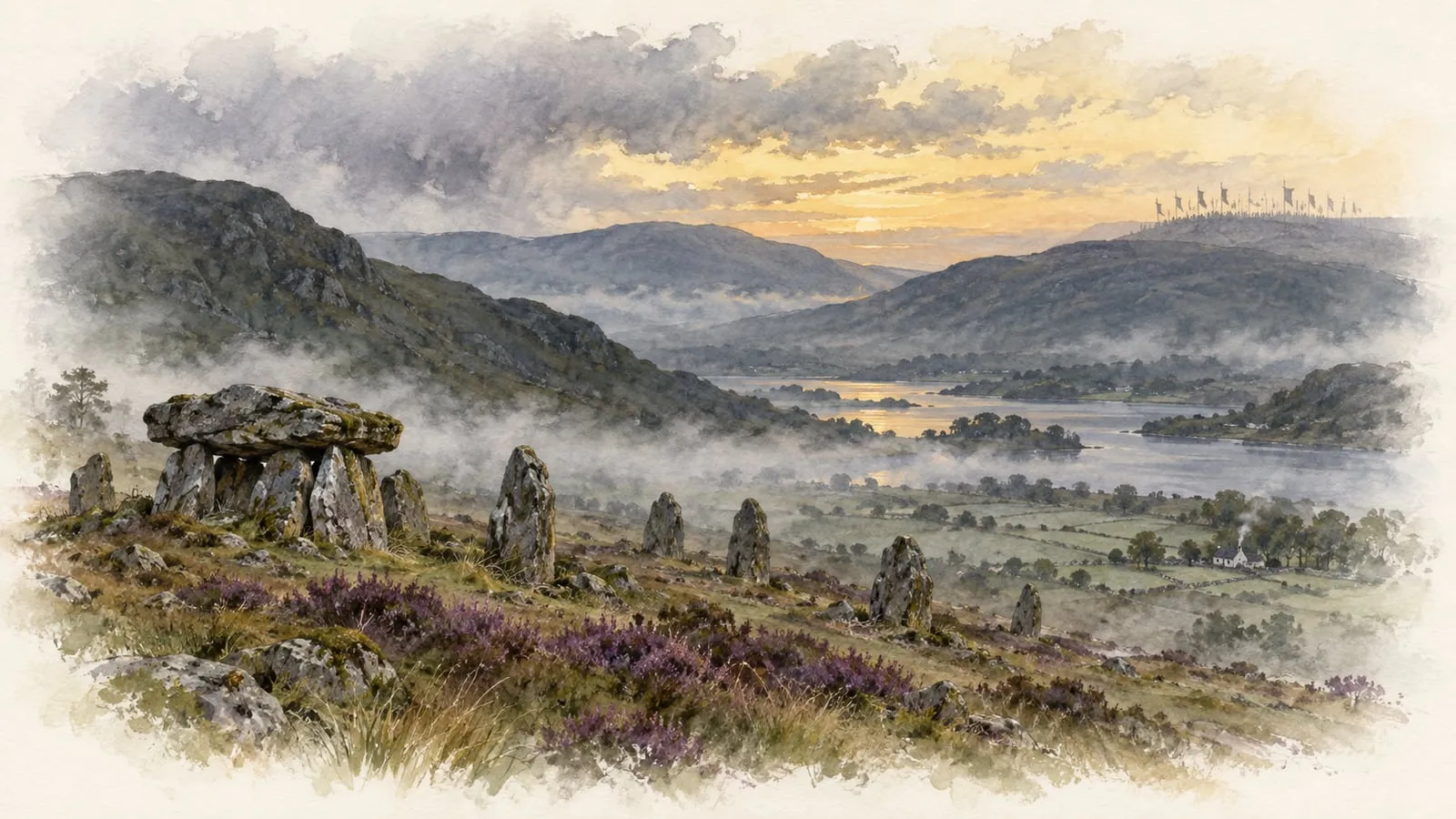
The voice becomes "We", those who "still labour by the cromlec on the shore" and the "grey cairn on the hill" as day "sinks drowned in dew". Weary of empires, they bow to the "Master of the still stars and of the flaming door", a god of stillness and of fire.
Themes
Prophecy and war
The armies are a glimpse of a battle to come, not a memory. The spears arrive "Suddenly", the armies are "unknown", and their cries "beat about my ears". Irish country prophecy foretold a great battle in the Valley of the Black Pig, and the poem gives that prophecy the feel of a waking dream.
Weariness with empire
The people of the second half are "weary of the world's empires". They live by ancient stones, not in cities, and their worship looks beyond politics to "the still stars". The poem sets an older, rural and sacred world against the power of empires, which in the 1890s included British rule in Ireland.
A sacred landscape
The cromlech and the cairn are prehistoric monuments, older than any empire. Those who "still labour" beside them keep a link with an ancient faith. The "Master" they bow to rules both "the still stars" and "the flaming door", calm and fire together, a power far beyond the battle.
Context
The poem was collected in The Wind Among the Reeds (Elkin Mathews, London, 1899). It draws on a prophecy from Irish folk belief that a last great battle would one day be fought in the Valley of the Black Pig.
Its sense of coming catastrophe links it with other poems in the book, especially "He mourns for the Change that has come upon Him and his Beloved, and longs for the End of the World", in which the Boar without bristles roots the stars out of the sky. In these years Yeats often imagined the end of an age in images drawn from Irish legend.
Form
Eight long lines, mostly of six beats, rhymed abba cddc ("spears", "eyes", "cries", "ears"; "shore", "dew", "you", "door"). The first four lines are one sentence of vision and the last four one sentence of prayer, so the poem splits cleanly in two, each half sealed by its enclosing rhyme.
Yeats's own note
All over Ireland there are prophecies of the coming rout of the enemies of Ireland, in a certain Valley of the Black Pig, and these prophecies are, no doubt, now, as they were in the Fenian days, a political force. I have heard of one man who would not give any money to the Land League, because the Battle could not be until the close of the century; but, as a rule, periods of trouble bring prophecies of its near coming. A few years before my time, an old man who lived at Lisadill, in Sligo, used to fall down in a fit and rave out descriptions of the Battle; and a man in Sligo has told me that it will be so great a battle that the horses shall go up to their fetlocks in blood, and that their girths, when it is over, will rot from their bellies for lack of a hand to unbuckle them. If one reads Professor Rhys’ Celtic Heathendom by the light of Professor Frazer’s Golden Bough, and puts together what one finds there about the boar that killed Diarmuid, and other old Celtic boars and sows, one sees that the battle is mythological, and that the Pig it is named from must be a type of cold and winter doing battle with the summer, or of death battling with life. For the purposes of poetry, at any rate, I think it a symbol of the darkness that will destroy the world. The country people say there is no shape for a spirit to take so dangerous as the shape of a pig; and a Galway blacksmith—and blacksmiths are thought to be specially protected—says he would be afraid to meet a pig on the road at night; and another Galway man tells this story: “There was a man coming the road from Gort to Garryland one night, and he had a drop taken; and before him, on the road, he saw a pig walking; and having a drop in, he gave a shout, and made a kick at it, and bid it get out of that. And by the time he got home, his arm was swelled from the shoulder to be as big as a bag, and he couldn’t use his hand with the pain of it. And his wife brought him, after a few days, to a woman that used to do cures at Rahasane. And on the road all she could do would hardly keep him from lying down to sleep on the grass. And when they got to the woman she knew all that happened; ‘and,’ says she, ‘it’s well for you that your wife didn’t let you fall asleep on the grass, for if you had done that but even for one instant, you’d be a lost man.’ ”
Professor Rhys, who considers the bristleless boar a symbol of darkness and cold, rather than of winter and cold, thinks it was without bristles because the darkness is shorn away by the sun.
The Battle should, I believe, be compared with three other battles; a battle the Sidhe are said to fight when a person is being taken away by them; a battle they are said to fight in November for the harvest; the great battle the Tuatha De Danaan fought, according to the Gaelic chroniclers, with the Fomor at Moy Tura, or the Towery Plain.
I have heard of the battle over the dying both in County Galway and in the Isles of Aran, an old Aran fisherman having told me that it was fought over two of his children, and that he found blood in a box he had for keeping fish, when it was over; and I have written about it, and given examples elsewhere. A faery doctor, on the borders of Galway and Clare, explained it as a battle between the friends and enemies of the dying, the one party trying to take them, the other trying to save them from being taken. It may once, when the land of the Sidhe was the only other world, and when every man who died was carried thither, have always accompanied death. I suggest that the battle between the Tuatha De Danaan, the powers of light, and warmth, and fruitfulness, and goodness, and the Fomor, the powers of darkness, and cold, and barrenness, and badness upon the Towery Plain, was the establishment of the habitable world, the rout of the ancestral darkness; that the battle among the Sidhe for the harvest is the annual battle of summer and winter; that the battle among the Sidhe at a man’s death is the battle of life and death; and that the battle of the Black Pig is the battle between the manifest world and the ancestral darkness at the end of all things; and that all these battles are one, the battle of all things with shadowy decay. Once a symbolism has possessed the imagination of large numbers of men, it becomes, as I believe, an embodiment of disembodied powers, and repeats itself in dreams and visions, age after age.