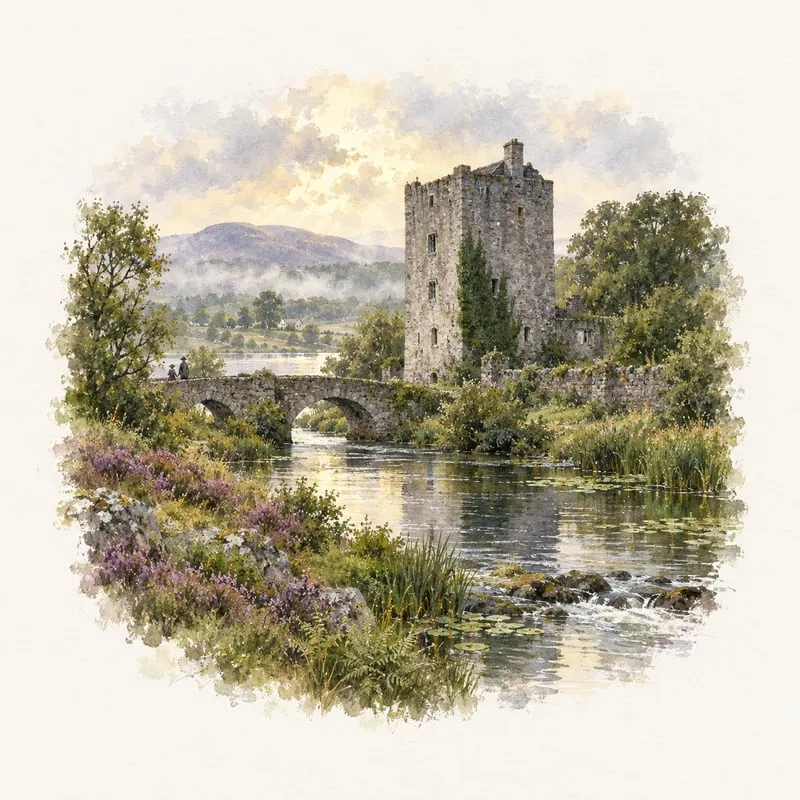
The tower
Ballylee is a tower house of about 1450, built by a branch of the de Burgo, or Burke, family, the Norman lords who settled in Connacht. It stands beside the Streamstown River with a cottage added around 1780 and a four-arched bridge of about 1825. By Yeats's time it was a roofless ruin on land that had passed from the Gregory estate to the Congested Districts Board, the state body that bought land to divide among small farmers.
Yeats bought the tower from the Board for 35 pounds; accounts date the sale to 1916 or to March 1917. He called it Thoor Ballylee, Thoor being his spelling of the Irish word for a tower.
Yeats at Ballylee
He married Georgie Hyde-Lees, known as George, on 20 October 1917, and with the architect William A. Scott and local builders the couple restored the tower and cottage over several years. The family first lived there in the summer of 1919, mostly in the cottage while the upper rooms were unfinished. Their daughter Anne, born in February 1919, is the child of "A Prayer for my Daughter", where the sea-wind screams "upon the tower" and "under the arches of the bridge".
Their longest stay came in 1922, from spring to September, as the Civil War began. "Meditations in Time of Civil War" was written then; in a note, Yeats recorded that Republicans blew up the old bridge one midnight, forbade the family to leave the house, and were otherwise polite. Its second part, "My House", opens with "An ancient bridge, and a more ancient tower". Damp, winter floods and his failing health ended the family's summers there by the end of the 1920s.
In the poems
"To be Carved on a Stone at Thoor Ballylee" records the restoration, with "old mill boards and sea-green slates" and ironwork "from the Gort forge"; the lines are cut on a stone tablet on the tower wall. "A Prayer on going into my House" asks a blessing on "this tower and cottage", and "In Memory of Major Robert Gregory" imagines friends at supper "Beside a fire of turf" in the tower.
The tower then became the symbol at the centre of the later work. "The Tower" gave its title to The Tower (1928), whose cover by Thomas Sturge Moore shows the building. "Blood and the Moon" declares "this tower is my symbol", and "A Dialogue of Self and Soul" begins at "the winding ancient stair". The late "Coole Park and Ballylee, 1931" follows the river from under his window down to the lake at Coole; it is still in copyright in the United States, so this site gives notes on it only.
Visiting today
After the family left, the tower fell into disrepair. The Kiltartan Society, founded by Mary Hanley, restored it with the support of Bord Fáilte and the Yeats family, and the poet Padraic Colum opened it as a museum on 20 June 1965, for the centenary of Yeats's birth. Floods in 2009 closed it; after restoration work begun by Fáilte Ireland in 2012, it reopened in June 2015 for the 150th anniversary.
The tower is now run by the Yeats Thoor Ballylee Society and opens in the summer season; check its own website before travelling. Inside, a winding stair links the rooms. The low ground by the river is prone to winter flooding. Coole Park is a few kilometres away.